The History of the Houses of Parliament
A medieval hall, a fire that destroyed everything around it, a competition won by an architect nobody expected, and a chamber rebuilt twice in a hundred years.
1097: a royal palace on the river
William II built Westminster Hall between 1097 and 1099 as the great hall of a royal palace, and for four and a half centuries the Palace of Westminster was a monarch's residence. Parliament met in it as a guest rather than an owner. The hall is the only substantial part of that palace still standing.
From royal house to parliamentary building
The Crown moved out in the sixteenth century and Parliament stayed. The Commons took over St Stephen's Chapel, sitting in the choir stalls facing each other across the aisle — which is where the confrontational layout of the modern chamber comes from. That accident of furniture has shaped British political argument ever since.
16 October 1834: the tally-stick fire
Two cartloads of obsolete wooden tally sticks were burned in the furnaces under the Lords chamber, the flues overheated, and by morning almost the whole Palace had gone. Westminster Hall survived, along with the Undercroft Chapel, the cloisters and chapter house of St Stephen's and the Jewel Tower. Everything else had to be replaced.
Barry, Pugin and a competition
A design competition followed and Charles Barry won it with a Gothic Revival plan. He employed A.W.N. Pugin, then a young draughtsman, on the drawings, and in 1844 invited him back to design the interiors. Between them they produced a building with about 1,100 rooms, 100 staircases and 4.8 kilometres of passageways — Barry's plan, Pugin's surfaces.
| Date | Event | What survives of it today |
|---|---|---|
| 1097–1099 | Westminster Hall built for William II | The walls, and the floor plan |
| 1393–1402 | Hammerbeam roof by Hugh Herland | The roof you stand under |
| 16 October 1834 | The tally-stick fire | Nothing — it destroyed almost all of the old Palace |
| 1840s–1870 | Barry and Pugin rebuild | The building you visit |
| 31 May 1859 | The Great Clock starts | Still running, conserved 2017–2022 |
| 10–11 May 1941 | The Commons chamber destroyed by bombing | Replaced in 1950 |
| 26 October 1950 | The new Commons chamber opens | The chamber on television today |
| 1987 | Inscribed as a UNESCO World Heritage Site | With Westminster Abbey and St Margaret's |
Dates published by UK Parliament's own heritage collections and checked in August 2026.
The towers, and which is which
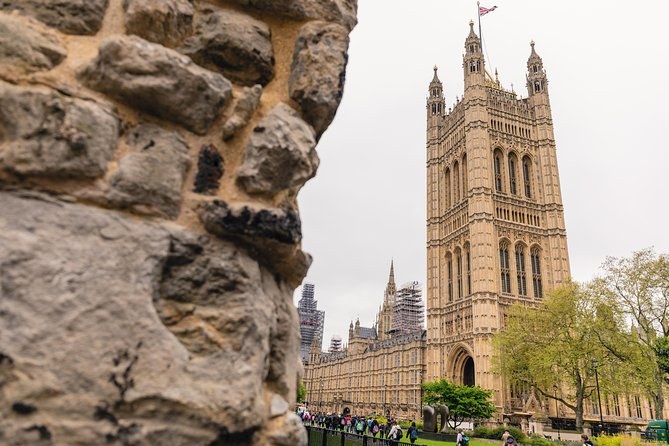
The Victoria Tower at the southern end is the taller of the two at 98.5 metres, and for many years it was the tallest and largest square stone tower in the world. The Elizabeth Tower at the northern end is 96 metres and carries the clock. Visitors almost always name the wrong one as the bigger, because the clock draws the eye.
Oliver Cromwell on the lawn
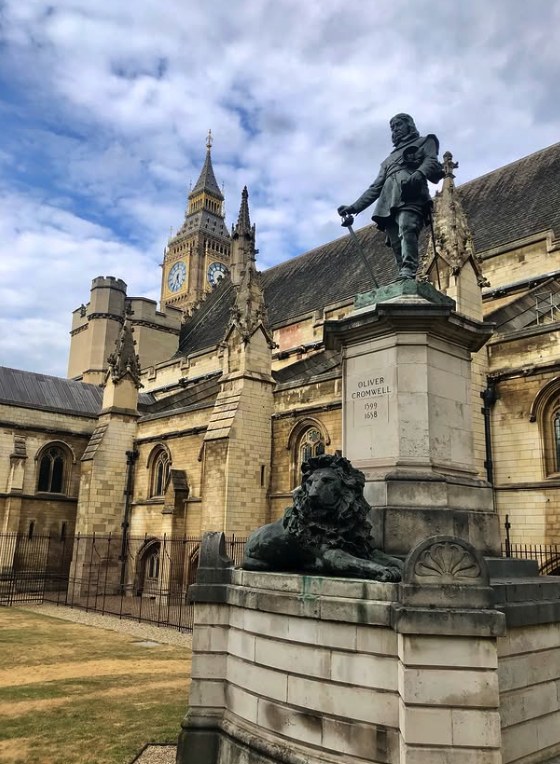
The bronze statue outside the west front, on the green that carries his name, shows Cromwell with a sword and a bible, a lion at his feet. It is a peculiar thing for a royal palace to display: the man who signed the death warrant of a king tried a hundred yards away in Westminster Hall. The visitor entrance is named after the green, and after him.
A working building, not a museum
Everything above is still in daily use, which is the fact that shapes a visit more than any other. The chambers close to visitors when they are needed, the tour calendar follows the parliamentary one, and a major restoration programme continues around the working building. What that means for your dates is on when Parliament sits, and what you will see when you get in is on the tour route. To book, London Parliament Tours compares every way in.
Tours built around the history
One guided visit through the building itself, and two that put the wartime years of this story on the ground where they happened.